1. Videos
  2. Rain & Thunderstorm

Rain & Thunderstorm

Rain and tree frogs roll into a gentle thunderstorm in the early hours, then soften back to steady rain and a dawn chorus by morning. Ten hours, black screen.

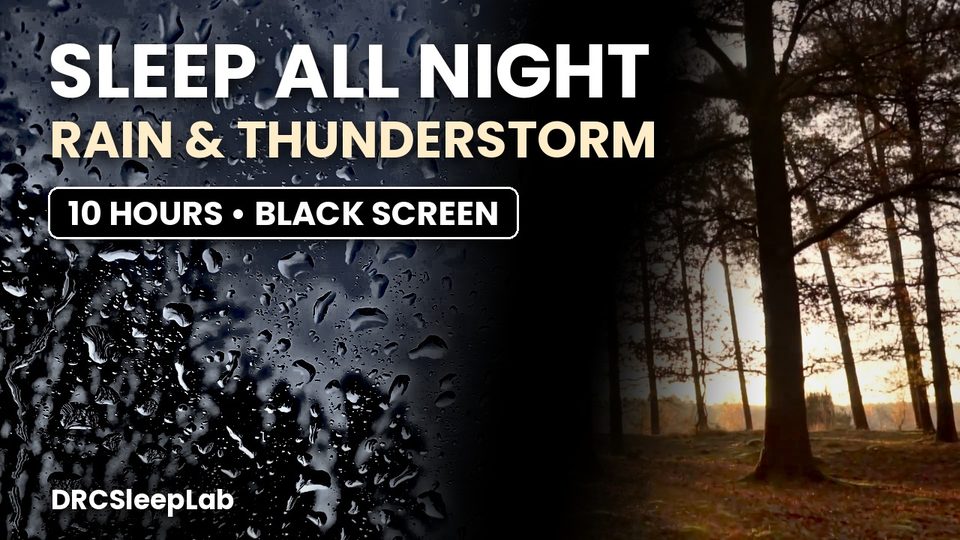
Sleep All Night, Rain and Thunderstorm, 10 hours black screen: rain on a window at night fading to black, then a forest sunrise
10 hoursBlack screenNo loops

Rain & Tree Frogs into a Gentle Thunderstorm, Softening to Dawn

It opens on real rain-on-window footage, graded to night, and fades to black within the first minute. The last half hour brings back the light with a forest sunrise, so you wake to morning instead of an alarm tone.

The shape of the night

Seven chapters, timed to the sleep cycle

Each tick in the storm marks one of the 52 thunder events.

    The research behind this video

    Why the night is shaped this way

    Each finding below shaped a specific choice in this video. How we research and build →

    FindingSourceWhat we did with it

    Sleep runs in cycles of about 90 minutes. Deep sleep is concentrated in the first 3 to 4 hours, and REM (dream) sleep fills more of the later hours.

    General sleep science (sleep cycle basics)

    The storm peaks in the first half of the night, then eases off for the lighter, dream-heavy hours toward morning.

    It takes a louder sound to wake someone early in the night than later. Waking thresholds change across the night.

    German Aerospace Center (DLR), noise and sleep research

    Thunder is placed in the early, deep-sleep hours (0:45 to 5:50) and none after that.

    Sudden sound events disturb sleep more than steady sound.

    Continuous vs intermittent traffic noise, Journal of Sound and Vibration (1987)

    Steady rain carries the whole night at one level. Thunder rolls in gently, with no sharp cracks, and stays within the storm hours.

    Steady broadband sound has limits. A 2026 University of Pennsylvania study (Basner et al., Sleep, 25 adults) linked pink noise at 50 dB to about 19 fewer minutes of REM sleep per night. It was a small study.

    ScienceDaily summary of the study

    We cut the white-noise hiss down, built the rain from individual drops, ease the level down about 3 dB toward morning, and suggest listening at low volume.

    Melodic alarm sounds were linked to less morning grogginess than harsh beeps.

    RMIT University research, via Neuroscience News

    The night ends with a slow dawn chorus, birds joining one by one from 8:45, instead of an abrupt sound.

    Listening to birdsong reduced anxiety in healthy adults.

    Scientific Reports (2022), via PMC

    Birdsong was chosen as the wake-up sound.

    Adults need 7 to 9 hours of sleep.

    General sleep guidance

    Someone asleep within the first 20 to 30 minutes reaches about 8 hours around 8:30 to 8:45, which is where the dawn chorus begins.

    For relaxation only, not medical advice. Do not listen while driving.

    How this video is built

    Ten hours of sound, generated as one night

    Most long sleep videos repeat a short clip. This one is rendered start to finish, so the rain you hear at hour seven has never played before.

    0repeats
    Not a loop

    The full 10 hours is generated as one continuous recording, so nothing cycles back around.

    1000s/ sec
    Individual raindrops

    Rain is built from thousands of separate drops per second plus roof taps, with tree frogs underneath. It is not white noise.

    52
    Thunder events

    Rolls, deep rolls and closer claps between 0:45 and 5:50, with the heaviest storm placed in the early-night hours, when deep sleep is most concentrated.

    −25LUFS
    Steady loudness

    Volume is held even through the night and eased down toward morning, designed so nothing jumps out at you.

    Credits

    • Dawn chorus: field recording by subax (Freesound, CC0)
    • Footage via Pexels by Artem Meziakov and Matthias Groeneveld
    • Sound design and production: DRC Sleep Lab